
Project Blog
Herzog August Bibliothek Blog Series – Histoire de Aurelio et Isabelle
By Anton Bruder
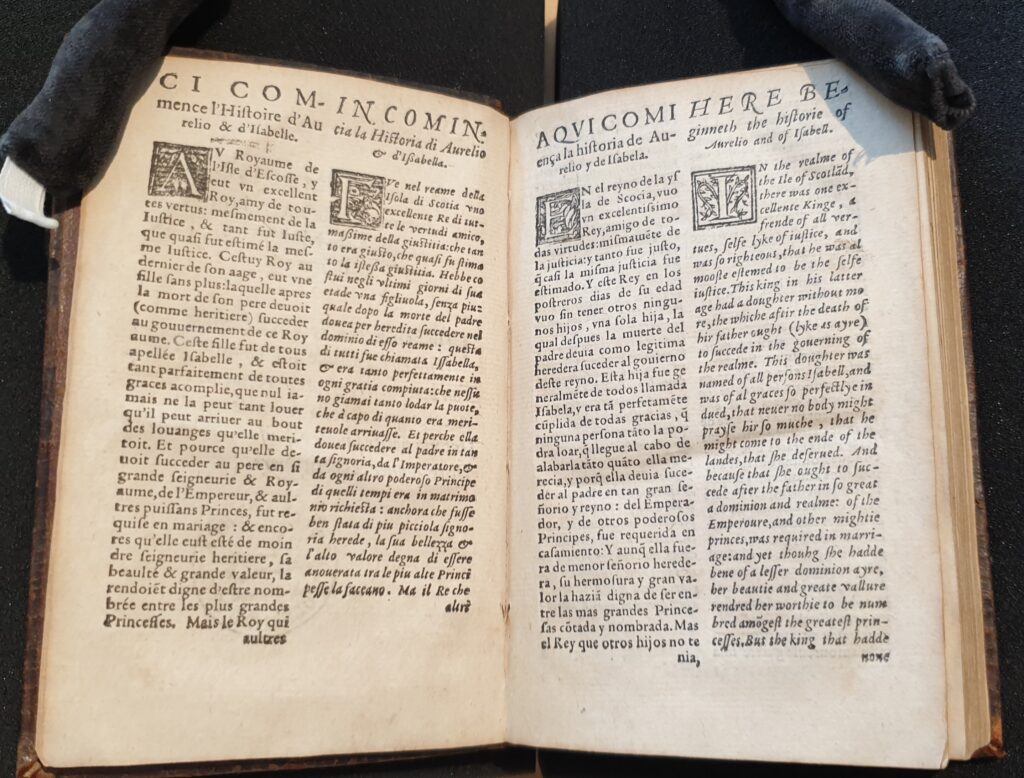
This curious little book has more claim than most to being considered truly unique: a short love story printed in not two, not three, but four vernacular languages side-by-side. Facing-page translations were not unheard of in the Renaissance, and then as now appear to have catered for a public of aspiring polyglots, offering short, easily digestible narratives usually in two languages: the native or original, and a translation into a foreign language. Editions abound of bilingual French-Italian and Spanish-Italian copies of the love story of Aurelio and Isabelle, a tale originally told in Spanish at the end of the fifteenth century but which attained Europe-wide fame in an Italian translation from 1521. This quadrilingual version, printed in an edition shared by the Antwerp printers Johannes Steelsius and Hans de Laet in 1556, is the only one of its kind, and takes the notion of facing page translation to a whole new level. Its reception and use in the sixteenth century forms the focus of my research at the Herzog August Bibliothek, where I currently hold a postdoctoral research fellowship. I have a hunch that there is more to this book than meets the eye, and that with it Steelsius and de Laet sought more to capitalise on the perceived social value of multilingualism than to provide readers with a useful language-learning tool.
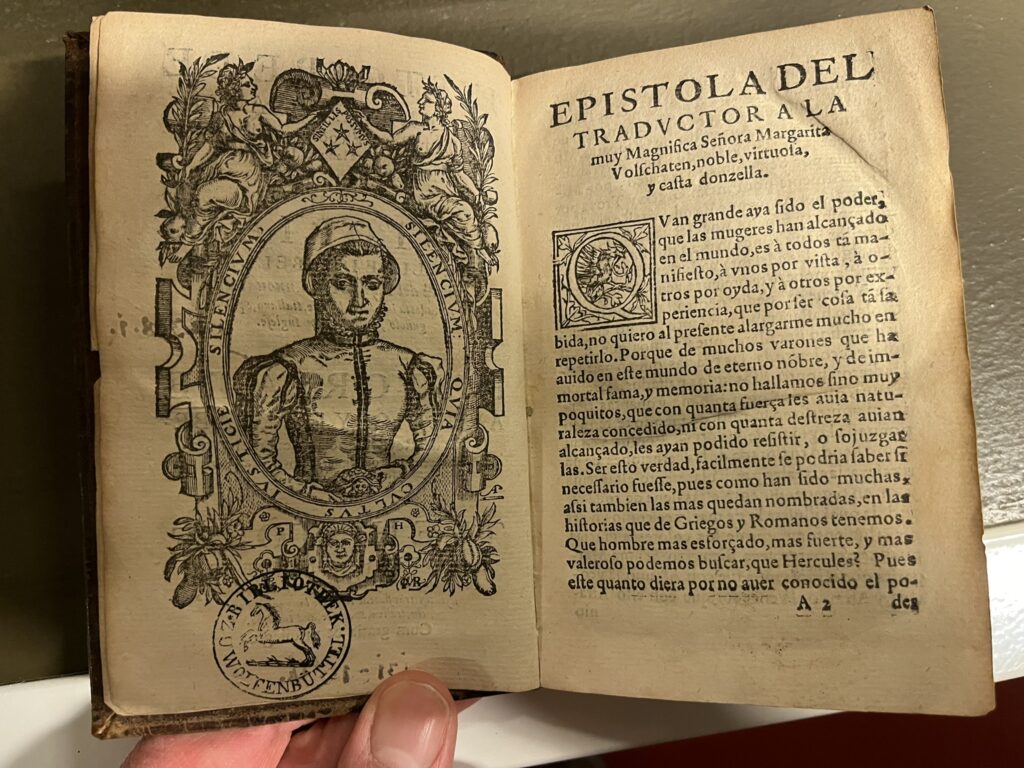
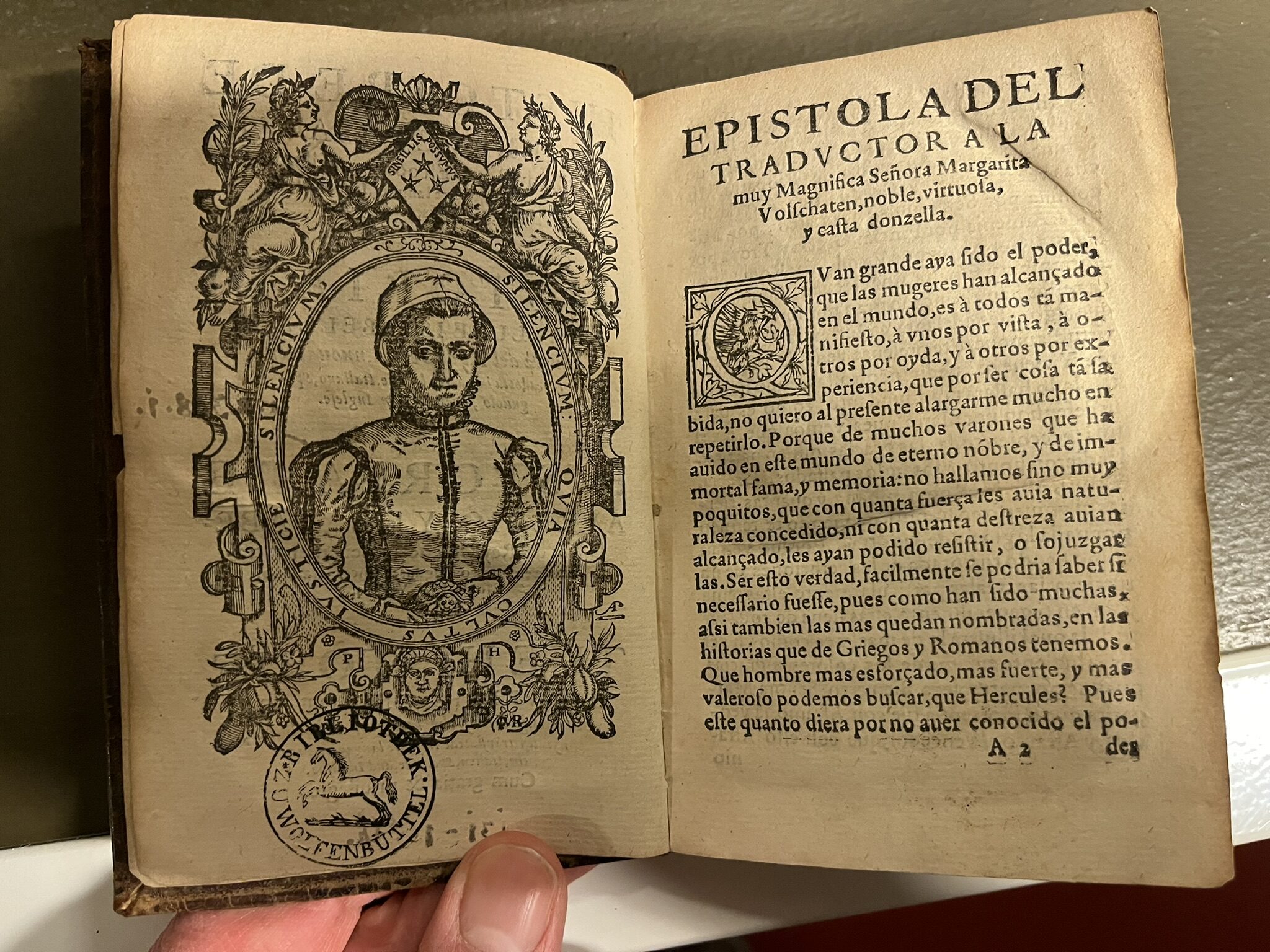
Clues supporting this interpretation lie in the mysterious dedicatory woodcut, to one Margarita Volschaten – an idealised Renaissance woman (“the pearl of great worth”, Matthew, 13:46), used here to market the value of literary multilingualism to a rising urban class with aspirations to traditional courtly culture. Note the little tortoise clutched in Marguerita’s hands (a symbol of domesticity) and the injunctions to silence (“silencium”) in the frame surrounding her portrait – a curious note on which to open a book which vaunts the multilingualism of its contents. Note also that the parallel translations alternate between Roman and Italic type; perhaps an editorial choice designed to keep the reader’s eyes from slipping too readily from one column to the next, it means that this book contains one of the earliest instances on record of the English language printed in the slanting Italic type associated with the handwriting of the Italian humanists.